
Industry guide
Healthcare marketing dashboard: report patients by service line, safely
A healthcare marketing dashboard brings ad, search, website, call and scheduling data into one report, so a hospital, clinic group or its agency can see which campaigns bring in new patients for each service line and location. This guide is for health system marketing teams, multi-site clinic groups and the agencies that report to them. It covers the KPIs worth tracking, how to structure reporting by service line, what HIPAA means for GA4 and Data Studio, how Meta's 2025 restrictions changed measurement, and a worked cost-per-patient example.
Quick answer
What should a healthcare marketing dashboard include?
A healthcare marketing dashboard should include spend, enquiries, scheduled appointments and new patients by channel, service line and location, plus cost per new patient, call answer rate and local search actions. Marketing data comes from ad platforms, GA4 and call tracking, while appointment counts come from scheduling systems as aggregated, de-identified totals.
- Report by service line and location, because one blended total hides where money is wasted.
- GA4 has no Business Associate Agreement, so keep it off patient portals and away from PHI.
- Data Studio and BigQuery can sit under the Google Cloud BAA if your data needs it.
- Meta's 2025 health restrictions mean ad-platform conversions undercount, so trust scheduling data instead.
What is a healthcare marketing dashboard?
It is a single live report that connects marketing activity to patient volume. For a hospital or a group of clinics, that means seeing how orthopedics, cardiology, women's health or urgent care campaigns turn into scheduled and completed first appointments, location by location.
The pages that rank for this topic today are mostly templates from reporting software vendors. They list sensible channel metrics, such as cost per click, organic traffic and email open rates, but they stop at the website form. None of the ones we reviewed explains how to bring in scheduling data or how HIPAA limits what you can track, and those two points decide whether the report is useful and safe.
We build these dashboards in Data Studio (formerly Looker Studio). Native connectors cover GA4, Google Ads, Search Console, YouTube and BigQuery. Partner connectors bring in Meta, LinkedIn and Google Business Profile. Scheduling and call data arrive as de-identified summaries in Google Sheets or BigQuery.
Which healthcare marketing KPIs should the dashboard track?
Track one KPI per stage of the patient path and name the system each one comes from. When numbers drop between two stages, the source tells you who fixes it: the agency, the web team, the call center or the scheduling team.
Keep vanity metrics, such as impressions and followers, on a secondary page. Leadership in a health system asks a narrower question: did this quarter's spend fill the clinics we wanted to fill?
| Stage | KPI | Usual source |
|---|---|---|
| Reach | Spend, impressions, clicks by campaign and service line | Google Ads natively; Microsoft Ads and Meta via partner connectors |
| Local search | Calls, direction requests and website clicks per location | Google Business Profile via partner connector |
| Website | Find-a-doctor searches, appointment request starts and completions | GA4 key events on public pages only |
| Phone | Inbound calls, answer rate, calls to appointments by source | Call tracking platform export |
| Scheduling | New patient appointments scheduled and completed by source | Scheduling or EHR export, aggregated |
| Efficiency | Cost per scheduled and per completed new patient | Calculated in Sheets or BigQuery |
| Reputation | New reviews and average rating by location | Google Business Profile via partner connector |
How should healthcare marketing reporting be split by service line?
Every number on the dashboard should carry two labels: a service line and a location. Without them, a strong urgent care campaign can hide a cardiology campaign that produced no appointments at all.
Agree the service line list with clinical and finance leaders first, then apply it everywhere. Campaign names in Google Ads and Meta should contain the service line code, landing pages should sit under predictable URL folders, and call tracking numbers should map to a service line. In Data Studio, a CASE statement on campaign name or page path then assigns each row to a service line, and a mapping table in Sheets handles the exceptions.
The same labels must exist in the scheduling summary. If the scheduling export uses department codes, keep a lookup table that turns them into your marketing service lines. That lookup is often the most valuable single artifact in the project, because it lets marketing and operations finally talk about the same numbers.
- Executive summary: new patients completed, cost per new patient and spend, by service line, against target.
- Service line pages: one per priority line, with campaigns, landing pages, calls and appointments.
- Locations: calls, answer rate, reviews and appointments per clinic or hospital campus.
- Access: call answer rate by hour and appointment lead time, where operations shares it.
- Channel detail: paid search, paid social, organic search and referral partners.
Worked example: cost per new patient by service line
Here is a hypothetical clinic group in one quarter. The numbers are illustrative, chosen to show the method, not industry benchmarks.
Orthopedics spends $18,000 across search and social and gets 300 enquiries, 120 scheduled new patient appointments and 100 completed. Dermatology spends $9,000 and gets 450 enquiries, 90 scheduled and 60 completed.
Cost per enquiry makes dermatology look twice as efficient: $20 against $60. Cost per completed new patient reverses the picture: orthopedics is $180 ($18,000 divided by 100) and dermatology is $150 ($9,000 divided by 60), much closer than the enquiry numbers suggested. Add the no-show gap, 33% of scheduled dermatology appointments not completed against 17% for orthopedics, and the real issue becomes clear. Dermatology does not need more budget, it needs reminder calls and better scheduling follow-up.
In Data Studio, cost per completed new patient is a calculated field, SUM(spend) / SUM(new_patients_completed), on a table where spend and appointment counts already share quarter, service line and location keys. Building that table in BigQuery or Sheets is more dependable than a live blend, which is capped at 5 sources and supports equality joins only.
Is a healthcare marketing dashboard HIPAA compliant?
It can be, if you design it so that protected health information never reaches tools that are not covered for it. The safest dashboards use only aggregated counts, such as completed new patients by week, service line, location and source, with no names, contact details, dates of birth or diagnoses.
GA4 is the tool to be most careful with. Google's own HIPAA guidance for Google Analytics says Google does not offer Business Associate Agreements for the service, that authenticated pages are likely to be HIPAA-covered and should not carry Google Analytics tags, and that unauthenticated pages related to the provision of health care are more likely to be covered as well. In practice, keep GA4 off patient portals and away from symptom checkers and appointment forms that collect health details.
Data Studio is different. Google's Data Studio HIPAA implementation guide says that customers subject to HIPAA who want to use Data Studio with PHI must first sign a Google Cloud Platform Business Associate Agreement, must not share PHI with Google support, and should restrict sharing of Data Studio assets outside the organisation. BigQuery is also on Google Cloud's list of HIPAA-covered products. That gives hospitals a route to keep sensitive operational data inside covered Google services when aggregation is not enough.
The legal context also moved. The HHS Office for Civil Rights published guidance on online tracking technologies in December 2022. In June 2024, a federal court in American Hospital Association v. Becerra vacated part of it, and OCR dropped its appeal in August 2024. Guidance on authenticated pages was not part of what the court vacated. This is a summary for planning, not legal advice, so involve your privacy officer before launch.
- Aggregate scheduling data before it reaches Sheets, BigQuery or Data Studio unless a BAA covers it.
- No GA4 or ad pixels on portals, intake forms or pages that collect health details.
- Sign the Google Cloud BAA before any PHI touches Data Studio or BigQuery.
- Restrict report sharing to your organisation's domain and review access every quarter.
How did Meta's 2025 health ad restrictions change measurement?
From January 2025, Meta began restricting how some health and wellness advertisers can share and use lower-funnel conversion events. Measurement firm Haus reported that the most affected brands may be unable to track on-site actions such as purchases or add-to-carts through the pixel or the Conversions API, while others see milder limits. Not every healthcare advertiser is affected in the same way.
For a dashboard, the consequence is simple: Meta's own conversion numbers can no longer be the source of truth for healthcare campaigns. If the platform cannot see appointment requests, its reported cost per result will look worse than reality, or disappear.
The fix is to measure outcomes outside the ad platform. Use dedicated call tracking numbers and UTM-tagged landing pages per campaign, count appointment requests in your own systems, and join those counts to Meta spend by week and service line in BigQuery or Sheets. The dashboard then compares channels on the same scheduling data, regardless of what each platform can track.
How do you connect scheduling and EHR data to Data Studio?
Data Studio has no native connector for EHR or practice scheduling systems, so the data arrives through an export. The usual pattern is a scheduled report from the scheduling system that counts new patient appointments by week, department, location and referral source, saved to a controlled location.
Small groups can land that summary in a Google Sheet owned by the organisation. Larger systems load it into BigQuery, partitioned by date, with a view that applies the service line lookup and drops anything not needed for reporting. Data Studio reads the view, never the raw export.
The quality of the referral source field decides how much you can trust the report. A short, fixed list of sources that matches campaign naming works well. Free-text fields need a cleaning table and regular review.
What mistakes make healthcare marketing reports misleading?
Most of the problems we see come from reports that measure activity instead of patients, or that mix very different services into one number.
- One total for the whole system, so a weak service line hides behind a strong one.
- Treating ad-platform conversions as appointments, which fails after Meta's 2025 restrictions.
- Counting every call as a new patient enquiry, including existing patients and billing questions.
- Ignoring call answer rate, so access problems look like marketing problems.
- Tags on patient portals or intake forms, which create HIPAA exposure.
- Dashboards built in an agency's own account, so the health system loses them when the contract ends.
Should you build a healthcare marketing dashboard or hire an agency?
Build it yourselves if you have one location, two or three channels, and someone who can update a weekly appointment count by hand. A one-page Data Studio report with cost per new patient by channel is already more useful than most vendor templates.
Hire help when you report across many service lines and sites, need scheduling data joined automatically, want HIPAA boundaries designed in from the start, or are an agency reporting to several healthcare clients under your own brand. If you only need a packaged tool with a login per client, a reporting SaaS may suit you better, and we will say so.
How Greenwolf Tech Labs builds healthcare marketing dashboards
We begin with a free review of your channels, campaign naming, call tracking and the scheduling exports you can produce. We agree service lines and KPI definitions with marketing and operations, build the data layer in Sheets or BigQuery, design the Data Studio pages, and reconcile totals against each source before handover.
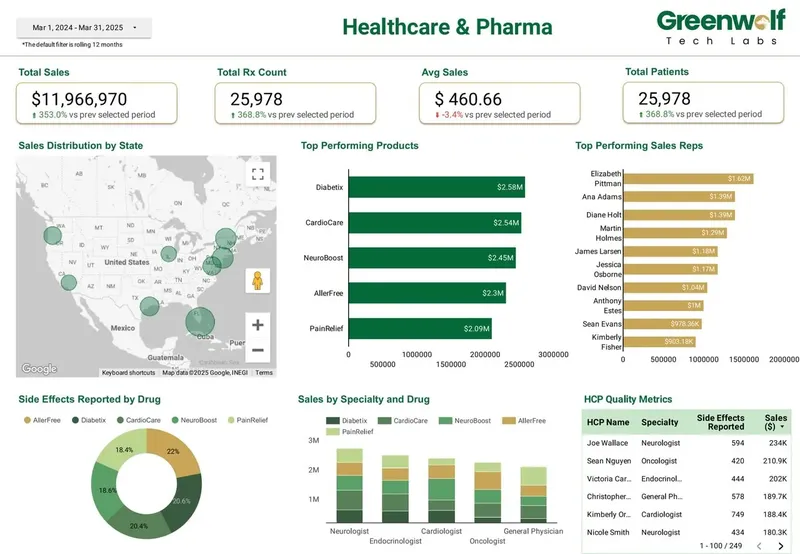
Our team has built Data Studio dashboards in healthcare and pharma, covering sales and prescription volume, product performance, sales by state and actual against forecast, and has delivered 100+ projects for 200+ clients. We quote a fixed price after the review, and every report and dataset sits in accounts your organisation owns.
FAQ
Frequently asked questions
What KPIs should a healthcare marketing team track?
Track spend, enquiries, scheduled and completed new patient appointments, and cost per completed new patient, split by service line and location. Add call answer rate and Google Business Profile actions for access and local search. Completed new patients is the number that links spend to growth.
Is Google Analytics HIPAA compliant?
No. Google states that it makes no representations that Google Analytics satisfies HIPAA and does not offer a Business Associate Agreement for it. Healthcare organisations can still use GA4 on general public pages, but must keep it off authenticated pages and away from any protected health information.
Can Data Studio be used with protected health information?
Google's Data Studio HIPAA implementation guide allows it only after the organisation signs a Google Cloud Platform Business Associate Agreement. Even then, PHI must not be shared with Google support, and sharing outside the organisation should be restricted. Most marketing dashboards avoid the issue by using aggregated counts.
How do you track patient acquisition from marketing campaigns?
Give each campaign its own call tracking number and UTM-tagged landing page, and make sure scheduling staff record a referral source from a fixed list. Summarise new patient appointments by week, service line and source, then join those counts to ad spend in BigQuery or Sheets.
Why do Meta ads show fewer conversions for healthcare campaigns?
Since January 2025, Meta has restricted lower-funnel conversion events for some health and wellness advertisers, so the platform may not see appointment requests at all. Measure outcomes in your own call tracking and scheduling data and compare channels there.
How often should a healthcare marketing agency report results?
A live dashboard updates daily, so the useful question is how often you review it. Many teams hold a monthly review of service line results and look at access metrics, such as call answer rate, weekly. Quarterly reviews suit budget moves between service lines.
Do hospital executives need a Data Studio licence to view the dashboard?
No. Data Studio is free for viewers. Data Studio Pro costs $9 per user per project per month and is only needed for creators, editors and managers who want team workspaces and admin controls.
Keep reading
Related pages
Get started
Tell us what your reporting has to do
Describe the dashboards you need, who reads them and where the data sits. We reply within one business day with an approach, the connectors involved and a fixed-price plan.
- Free 30-minute reporting review
- Fixed quote before any work starts
- Everything built and owned in your Google account
Prefer email? info@greenwolftechlabs.com
Get a free proposal
Two lines is enough to start.