
Agency guide
Outsource client reporting: a decision guide for marketing agencies
To outsource client reporting, an agency hands the building, refreshing and checking of client reports to an outside team, while its own account managers keep the client relationship and the commentary. This guide is for agency owners and operations leads deciding whether to do that, who to hand it to, and what to lock down before they sign. It covers the options side by side, a worked cost example, a handover checklist, contract terms and the cases where outsourcing is the wrong call.

Quick answer
Should a marketing agency outsource client reporting?
Outsource client reporting when report assembly takes more than a few hours per client each month, reports look different from client to client, or broken connectors reach clients before your team notices. Keep strategy and commentary in-house. Make sure every report and data source is owned by an agency account, not the supplier's.
- Outsource the assembly and maintenance of reports, never the client conversation or the commentary.
- Compare the full in-house cost, including salary, tools and fixes, against a fixed outside quote.
- Insist that reports, data sources and credentials live on accounts your agency controls.
- Run one reporting cycle in parallel before switching every client to the new system.
What does it mean to outsource client reporting?
It means an outside team builds and runs the reports your clients receive, usually under your agency's brand. The supplier connects the data, designs the templates, keeps the numbers flowing and fixes what breaks. Your team reads the finished report and tells the client what it means.
The scope varies a lot between suppliers, which is why quotes are hard to compare. Some only build a template once and leave. Others run the whole cycle every month: onboarding new clients, checking totals against the ad platforms, sending scheduled deliveries and fixing connectors. Before you talk to anyone, write down which of these jobs you want off your team's plate.
In Data Studio (formerly Looker Studio), the work splits into three layers. The data layer is connectors, blends, calculated fields and, for larger rosters, a BigQuery warehouse. The report layer is the master template and one copy per client. The operations layer is sharing, credential ownership, delivery schedules and monitoring. Most agencies feel the pain in the operations layer first, because Data Studio has no built-in client management and gives no warning when a connector breaks.
- Usually outsourced: data connections, templates, client copies, refresh checks, connector fixes, scheduled sends.
- Sometimes outsourced: KPI definitions, BigQuery modelling, onboarding new clients end to end.
- Rarely outsourced, and best kept in-house: commentary, recommendations and the monthly client call.
Should you outsource client reporting or keep it in-house?
There are five realistic ways to run client reporting, and each one moves cost and risk to a different place. The right answer depends on roster size, how many channels each client runs, and whether anyone on your team actually enjoys building data pipelines.
Client expectations are rising regardless of which route you pick. In the AgencyAnalytics 2026 Agency Benchmarks Report, a survey of 494 agency professionals, 44% said clients now expect faster turnaround than before. Slow, manual reporting is harder to defend than it was.
| Option | What you pay for | Best fit | Main risk |
|---|---|---|---|
| Account managers build reports | Their time, usually unbilled | Under ten clients, one or two channels each | Reporting eats the hours meant for strategy |
| Hire an in-house analyst | Salary, benefits, tools, management time | Large roster with steady, complex needs | Single point of failure when they leave |
| Reporting SaaS tool | Per-client or per-seat subscription | Standard channel reports, little custom logic | Costs scale with clients; limited custom modelling |
| Freelancer | Hourly or per-project fee | A one-off template or a quick fix | Availability and handover if they move on |
| Reporting agency, white-label | Fixed build fee, then a retainer or per-client fee | Growing roster, mixed channels, custom KPIs | Picking a supplier who keeps ownership of your assets |
How much does it cost to outsource client reporting compared with doing it yourself?
The fair comparison is the full in-house cost against a fixed outside quote for the same scope. Most agencies only count the outside quote, because their own reporting time is never invoiced and so feels free.
Here is a worked example. Assume an agency with 20 clients spends 3 hours per client per month exporting data, updating slides and checking numbers. That is an illustration, not a benchmark, so replace it with your own timesheet figures. It comes to 60 hours a month, or 720 hours a year.
The US Bureau of Labor Statistics puts the median wage for market research analysts at $78,760 a year, or $37.87 an hour, as of May 2025. At that hourly rate, 720 hours costs about $27,266 in wages alone. Add benefits, the reporting tools those hours depend on, the time a manager spends reviewing, and the fixes that land in a busy week, and the real figure is higher. If account managers do the work instead, the cost also includes the client work they did not do.
Outside suppliers usually price the same work in one of three ways: a fixed fee to build the system, a monthly retainer to run it, or a fee per client report. Our guide to Data Studio agency pricing explains each model and what should sit inside it. Whatever the model, ask the supplier to quote against your written scope so you can set it next to your own 720-hour figure, or whatever your timesheets show.
- Count hours from timesheets for one full month, not from memory.
- Include the time spent fixing broken reports and answering client questions about numbers.
- Add tool costs that disappear if the work moves: partner connectors, slide software, spreadsheet add-ons.
- Keep Data Studio Pro separate: it is $9 per user per project per month for editors, and client viewers need no licence.
What should stay in-house when you outsource reporting?
Keep everything the client pays your agency to think about. The supplier should hand you a report that is correct, current and consistent. Your account manager should add the two or three sentences that explain why a number moved and what you plan to do about it.
Also keep the decisions about what you measure. An outside team can propose KPI definitions, but your agency should sign off on how a lead, a conversion or a qualified opportunity is counted, because you defend those numbers in front of the client. Write the definitions down once and make the supplier build to them.
- Commentary, insights and recommendations in each report.
- The monthly or quarterly review call with the client.
- Final sign-off on KPI definitions, targets and goal lines.
- Ownership of every client data source and report.
What do you need to hand over to a reporting partner?
A clean handover takes most of the risk out of outsourcing. Suppliers lose time when access requests drip in over weeks or when campaign naming differs from one client to the next. Prepare these items before kickoff and the first reports usually arrive faster.
Access matters most. Give the supplier the access they need through accounts your agency owns. Avoid sharing personal logins. In Data Studio, a data source using the owner's credentials stops working if that owner's access is removed, so credentials should sit on a shared agency account that outlives any one person, at your agency or at the supplier.
- A client register: every client, the channels they run, the account IDs and the reporting cadence.
- Access to ad platforms, GA4 properties, Search Console and CRMs, granted from agency-owned accounts.
- Your KPI definitions and any client-specific goals, such as target CPA or ROAS.
- Campaign naming conventions, or a note of where each client breaks them.
- Brand assets: your agency logo and colours, plus each client's logo for white-label covers.
- Two or three current reports that clients like, and one they complain about.
- The delivery calendar: which day each client expects their report, and in what format.
Which contract terms protect an agency that outsources reporting?
Ownership is the term that matters most. Reports, data sources, BigQuery projects and connector accounts should be created in, or transferred to, accounts your agency controls. If the supplier builds everything in their own account, leaving them means rebuilding from scratch.
Confidentiality comes next. A white-label supplier sees your client list, your clients' spend and often their CRM data. The agreement should cover confidentiality, who on the supplier's team can access what, and that the supplier never contacts your clients unless you ask.
Then pin down service levels. Ask how quickly a broken report is fixed, how report checks are scheduled before each send, what a retainer includes, and how new clients are priced. Finally, agree an exit: documentation of every calculated field, blend and source, and a handover call, included in the price rather than billed when you leave.
- All reports and data sources owned by agency accounts, from day one.
- Credentials on a shared agency account, never a supplier employee's login.
- Confidentiality and a no-contact clause for your clients.
- Written response time for broken reports and a pre-send check.
- Documentation and an exit handover included in the fee.
How do you outsource client reporting step by step?
Move in stages rather than switching every client at once. A pilot on a small number of real accounts shows you how the supplier works before your whole roster depends on them.
The parallel cycle is the step agencies most often skip. For one month, produce reports both ways and compare totals line by line. Differences usually come from date ranges, attribution settings, time zones or currency, and finding them before a client does protects your credibility.
- Audit: list clients, channels, current reports, hours spent and the problems clients raise.
- Scope: decide which layers you are handing over and write down the KPI definitions.
- Pilot: build the master template and test it on two real clients with different channel mixes.
- Parallel run: produce one cycle both ways and reconcile totals against the platforms.
- Rollout: copy, connect and brand a report for each remaining client.
- Operate: agree the monthly checks, the change process and how new clients are added.
What are the most common mistakes when agencies outsource reporting?
Most failed outsourcing arrangements fail on ownership or scope, not on chart design. Each of these mistakes is cheap to prevent before signing and expensive to undo afterwards.
- Letting the supplier own the reports, so the agency cannot leave without losing them.
- Buying a template build when the real problem was monthly maintenance.
- Skipping the parallel run, so a client spots a mismatched total first.
- Ignoring GA4 API quotas: at 14,000 tokens per project per property per hour on standard properties, a heavy report opened by many viewers can hit quota errors.
- Forcing every channel into one blend, when blends are limited to 5 sources and equality joins, instead of modelling the data in Sheets or BigQuery.
- Outsourcing the commentary as well, so reports arrive on time but say nothing.
When should an agency not outsource client reporting?
Outsourcing is not always the right answer. If you have a handful of clients on one or two channels and reporting takes an hour each month, a standard template or a reporting tool is cheaper and simpler. If your agency sells analytics as a core service, reporting skill is part of your product and belongs on your own team.
It is also the wrong move while your KPI definitions are still unsettled. An outside team can only build to definitions you have agreed. If you are still debating what counts as a lead, settle that first, then outsource the build. Our guide to client reporting tools for agencies covers the tool route if that suits you better.
How does Greenwolf Tech Labs run outsourced client reporting?
We build white-label Data Studio reporting for marketing agencies and, if you want, run it every month. Everything is created in accounts you own, we stay invisible to your clients, and we document every source and calculated field so you could take the work back at any time.
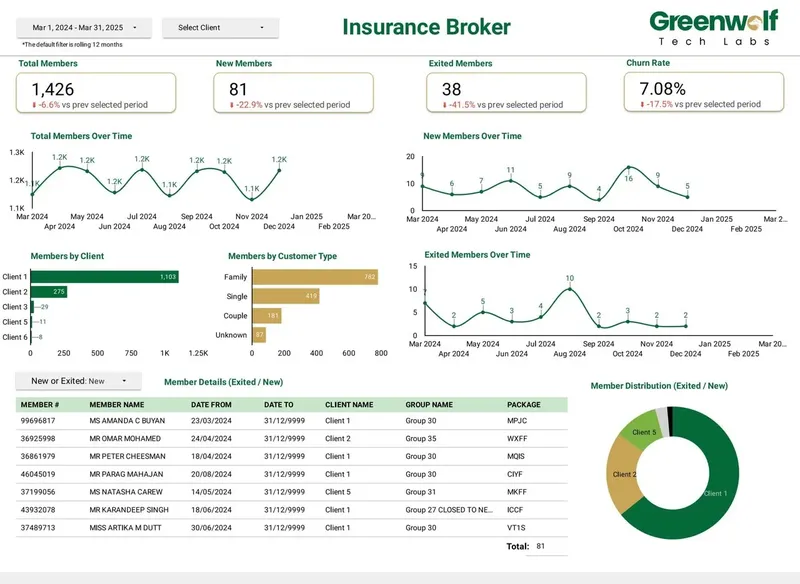
We quote a fixed price after a free review of your roster, channels and current reports. Our team has delivered 100+ projects for 200+ clients across 50+ locations, and includes people with experience from top consulting firms. In one reporting automation project for an Australian insurance brokerage, report preparation fell from 4 to 5 hours to under 5 minutes, which shows how much of reporting time is assembly that a well-built system removes.
Case study · Insurance brokerage, Australia
From 4-5 hours of spreadsheet work to a report in under 5 minutes
Monthly reports were assembled by hand from inconsistent .xls files sent by several insurers. The files now land in Google Drive, are mapped into one central sheet with the business rules applied, and feed a Data Studio dashboard.
- Report time: 4-5 hours to under 5 minutes
- Reporting accuracy: about 75% to 99%
- Visibility across insurers: limited to real time, with filters
FAQ
Frequently asked questions
Is it worth outsourcing client reporting for a small agency?
It depends on hours, not headcount. If reporting takes more than a few hours per client each month, or your account managers are building slides instead of talking to clients, outsourcing usually pays for itself. If you have a few clients on one or two channels, a template or a reporting tool is often enough.
Will my clients know that reporting is outsourced?
Not if you use a white-label supplier. Reports carry your agency's branding and your client's logo, and sharing comes from your agency's account. Make the supplier agree in writing never to contact your clients unless you ask.
Who should own the reports when reporting is outsourced?
Your agency. Reports, data sources, BigQuery projects and connector accounts should sit in accounts you control, with credentials on a shared agency account. Otherwise, changing supplier means rebuilding everything.
How long does it take to outsource client reporting?
It depends on roster size, channel mix and how consistent your campaign naming is. A sensible plan runs a pilot on two clients, one parallel reporting cycle and then a rollout to the rest. Ask suppliers for a fixed timeline after they have seen your accounts.
Can I outsource Looker Studio reporting now that it is called Data Studio?
Yes. Google renamed Looker Studio back to Data Studio in April 2026, and existing reports and data sources moved over automatically. Any supplier who built Looker Studio reports works in the same product today.
What is the difference between outsourced reporting and a reporting tool?
A tool gives you software that your team still configures, maintains and checks. Outsourced reporting gives you people who build and run the reports for you, often in Data Studio, with custom KPIs and data modelling a tool may not support. Many agencies use both: a supplier builds on top of the data tools they already pay for.
What should an outsourced reporting retainer include?
At minimum: monitoring for broken connectors, a check of totals before each scheduled send, onboarding of new clients, and small template changes. Ask for the inclusions, the response time for fixes and the per-client price for growth in writing.
Keep reading
Related pages
Get started
Tell us what your reporting has to do
Describe the dashboards you need, who reads them and where the data sits. We reply within one business day with an approach, the connectors involved and a fixed-price plan.
- Free 30-minute reporting review
- Fixed quote before any work starts
- Everything built and owned in your Google account
Prefer email? info@greenwolftechlabs.com
Get a free proposal
Two lines is enough to start.